Calculate Fabric Yardage
Select a project for preset values, or enter custom dimensions.
Preset guide: Each card loads the dimensions and fabric width for that project. For example, the Throw Pillow preset sets two 18×18" pieces (front + back) on 54" fabric with ½" seam allowance — click to see the yardage change instantly. The Curtain Panel preset uses 92" drop length to account for hemming and header. The Knee-Length Dress uses the widest pattern piece as the width input, which gives a conservative estimate.
Fabric Yardage by Project
Need fabric for a specific project? Use our specialized calculators:
How to Use the Fabric Yardage Calculator
- Select fabric width — Common widths from 36" quilting cotton to 108" wide drapery. Enter custom width if yours isn't listed.
- Enter piece dimensions — Length and width of each piece you need to cut from the fabric.
- Adjust seam and waste — Standard seam allowance is ½". Beginners should use 10-15% waste.
- Optional: enter price — Add the price per yard to see your total fabric cost instantly.
- Read the result — Results update in real time. Shows yards needed, multi-unit conversions, and estimated cost.
How to Measure for Fabric Yardage — Step by Step
Getting accurate measurements before you use the calculator saves time and prevents under-buying. Here's the method I use for every project:

- Measure the longest dimension — For a cushion, that's the length from front to back. For curtains, it's the finished drop from rod to hem. Enter this as "Piece Length."
- Measure the widest dimension — The widest point of the piece your fabric needs to cover. For pillows and cushions this is the width; for clothing it's the widest pattern piece (usually the bodice or skirt panel). Enter this as "Piece Width."
- Count how many identical pieces you need — A throw pillow needs 2 (front + back). Curtains need 2 panels. A dress may need 4–6 main pattern pieces — group the largest ones and enter the count.
- Account for seam allowance — Standard is ½". If you're using a commercial pattern, check its seam allowance — European patterns often use ⅝" (1.5 cm).
- Add waste for shrinkage — Cotton shrinks 3–5% on the first wash. Add 10% waste as a baseline; go to 15% if you're new to sewing or working with slippery fabrics like silk charmeuse.
Step 2: Pieces per width = fabric width ÷ adjusted piece width (round down)
Step 3: Rows needed = total pieces ÷ pieces per width (round up)
Step 4: Total inches = rows × adjusted piece length
Step 5: Yards = (total inches ÷ 36) × (1 + waste %)
Example: an 18×18" pillow needs 2 pieces (front + back). On 54" fabric with ½" seam allowance: each piece is 19" × 19". Two pieces fit side by side across 54", so only 1 row of 19" = 19" total. With 10% waste: 19" ÷ 36 × 1.1 = 0.58 round up to ⅔ yard.
Formula verified against Reader's Digest Complete Guide to Sewing and WCAA curtain fullness standards. Checked against real cutting layouts for all project types listed in the table below.
How to Save on Fabric — Tips for Beginners
Fabric is often the most expensive part of a sewing project. These strategies help you buy less without compromising your finished piece:
- Choose wider fabric when possible. Switching from 45" to 60" fabric reduces yardage by roughly 25% for the same project. The width comparison feature below the calculator shows you the difference instantly — try it before you buy.
- Nest your pattern pieces. Before cutting, arrange all pattern pieces on the fabric width to find the most efficient layout. The calculator assumes ideal nesting; if you know your layout will be less efficient, add 5% to the waste percentage.
- Buy whole-yard cuts for small projects. A throw pillow on 54" fabric needs only ½ yard, but fabric stores cut in ¼-yard increments. Buying a full yard gives you leftover fabric for matching accent pillows or small repairs — often cheaper per yard too.
- Pre-wash to prevent post-sewing shrinkage. Cotton and linen fabrics shrink after the first wash. Pre-washing means your ½" seam allowance stays ½" and your finished project fits as intended — no extra fabric wasted on remakes.
Standard Fabric Widths
| Width | Common Uses |
|---|---|
| 36" (91 cm) | Quilting cotton, lightweight prints |
| 45" (115 cm) | Blouses, shirts, dresses, light curtains |
| 54" (140 cm) | Home decor, medium upholstery, pants |
| 60" (150 cm) | Upholstery, drapery, coats |
| 108" (275 cm) | Wide drapery, sheers, seamless bedding |
Yardage by Project Type
Rough yardage estimates for common projects on 54" fabric (use the calculator above for exact results):
| Project | Yardage (54") | Notes |
|---|---|---|
| Throw pillow (18×18") | ½ yd | Front + back, 2 fit per width |
| Euro pillow (20×20") | ⅔ yd | Front + back, 2 per width |
| Lumbar pillow (12×20") | ½ yd | Front + back |
| Curtain panel (84" drop) | 2½ yd | Per panel, includes hem |
| Knee-length skirt | 1 yd | Straight, 45" fabric |
| Simple dress (knee) | 2–2½ yd | Varies by size and style |
| Queen quilt top | 6½ yd | 45" quilting cotton |
| Tablecloth (48×72", 12" drop) | 3 yd | 60" fabric recommended |
Frequently Asked Questions
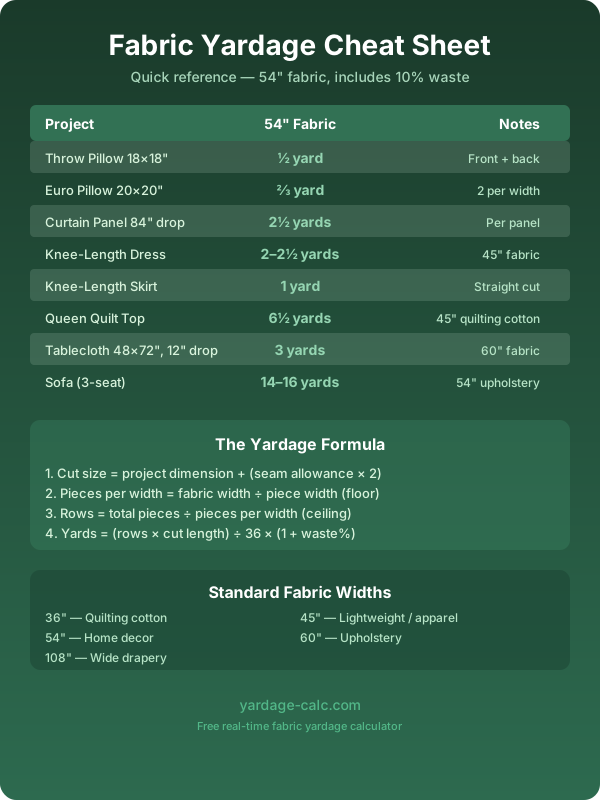
Free Download: Fabric Yardage Cheat Sheet
I keep a printed copy of this in my sewing kit — it saves me from pulling out my phone every time I'm at the fabric store. Covers the most common projects and the yardage formula at a glance.
Download Cheat Sheet (SVG)